An Introduction to Bryophytes at Glencree and Cruagh Woods
A day with Dr Joanne Denyer and the National Biodiversity Data Centre, learning to tell a moss from a liverwort at Glencree, then trying it for real in Cruagh Woods.
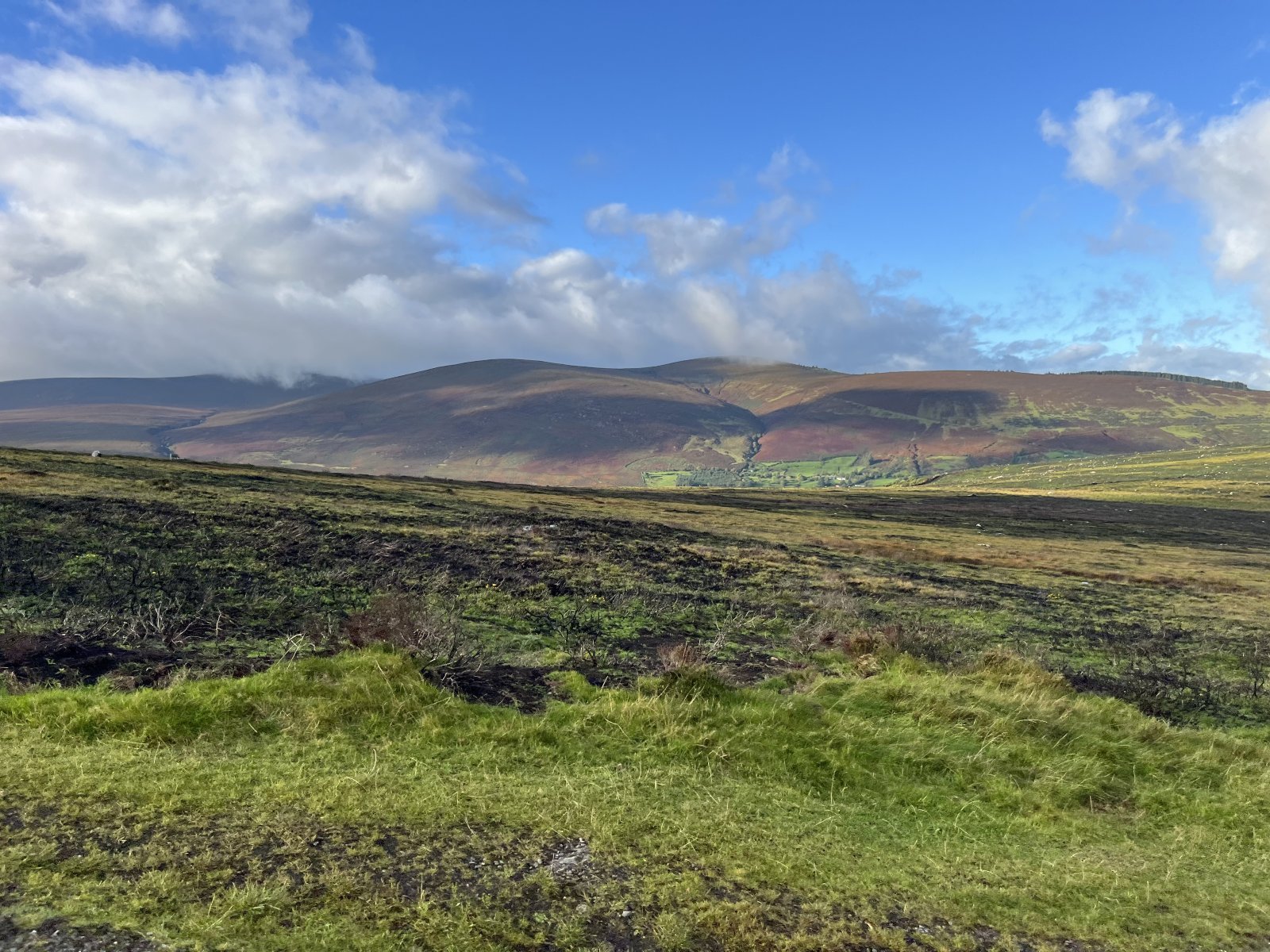
The Wicklow uplands on the drive to Glencree.
On 9 October I headed up to the Glencree Centre for Peace and Reconciliation in Co. Wicklow for an introduction to bryophytes, the mosses and liverworts. The day was run by the National Biodiversity Data Centre and led by Dr Joanne Denyer, an ecologist and bryologist.
Getting there
It was a lovely morning for it, with open mountain and great views most of the way up. I'd been to Glencree once before, just stopping in while driving the Old Military Road, and it's a beautiful spot. Very peaceful, as the name would suggest, with old trees all around and some lovely beech (Fagus sylvatica) on the way in.
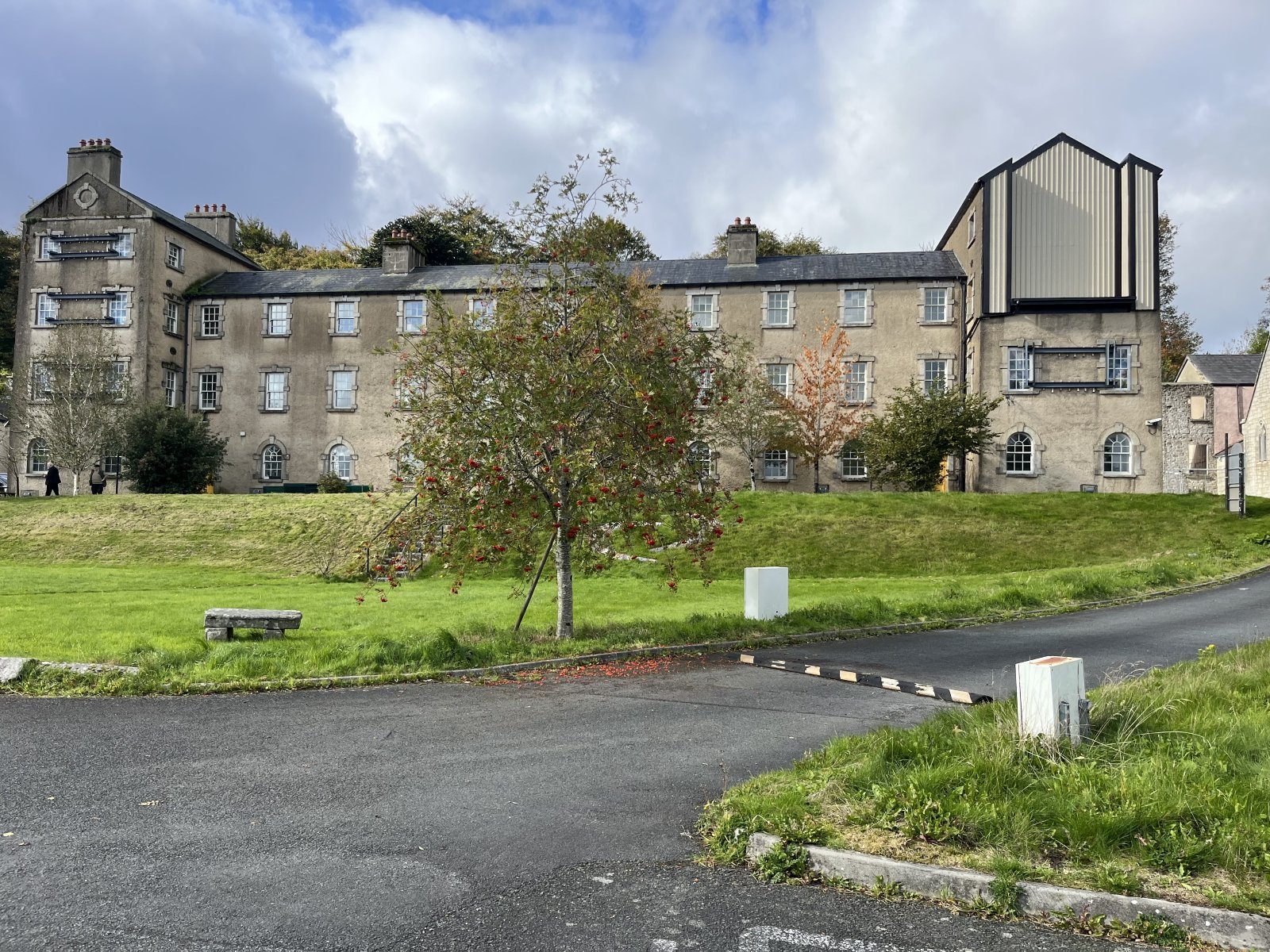
The Glencree Centre, with a rowan in full berry out front.
The main building is old stone with granite around the windows, refurbished inside. I had a quick chat with Una from the National Biodiversity Data Centre on the way in, then went upstairs to meet Joanne and the rest of the group.
There was a big table in the middle of the room with a handful of enthusiasts around it. One or two had a background in ecology, a few already knew a bit about bryophytes, and the rest of us were there fresh. At the back of the room was a second table laid out with specimens: five liverworts, two Sphagnum mosses (one of them Sphagnum rubellum, the reddish one) and a good selection of other mosses.
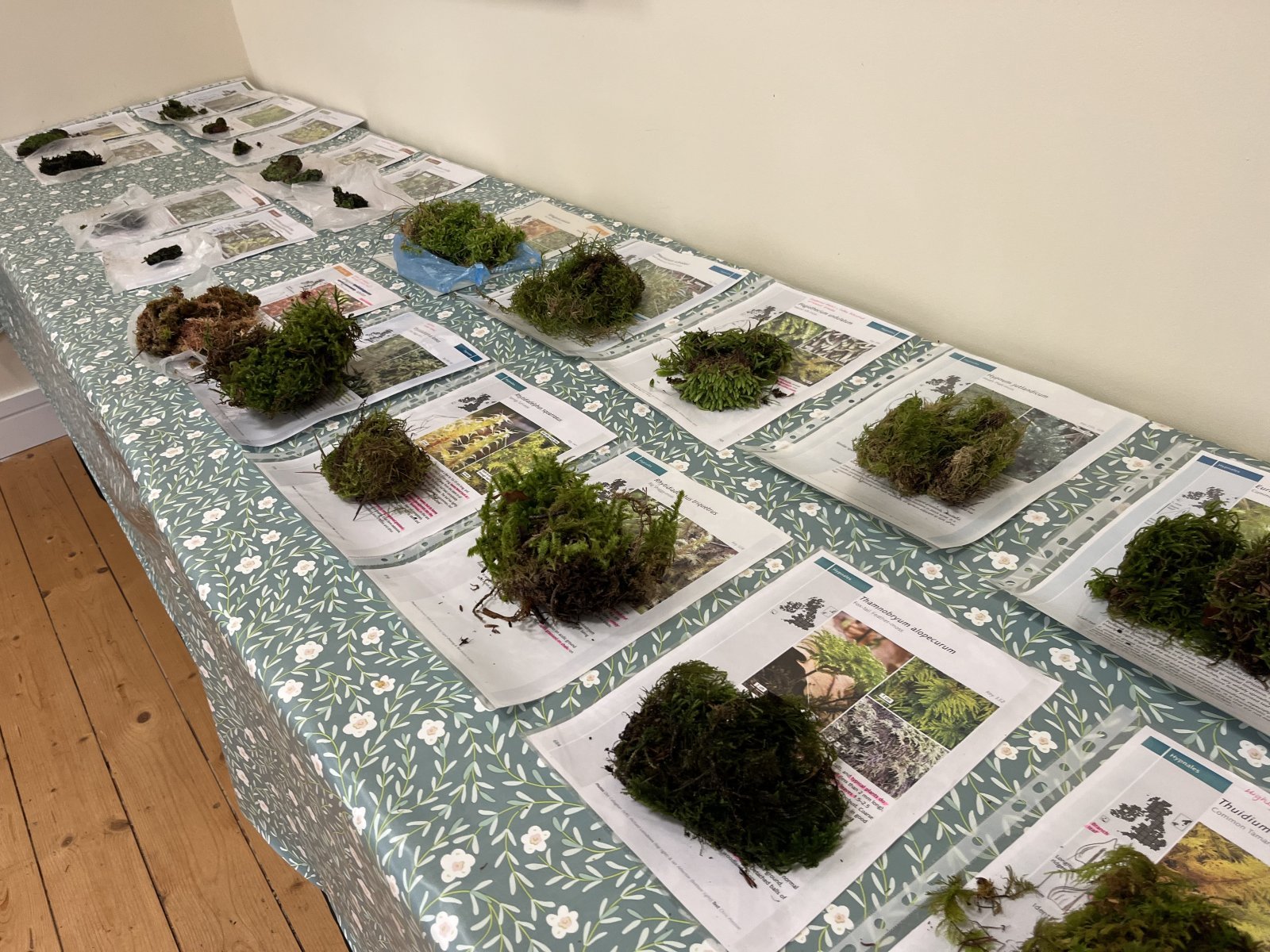
The specimen table, each sample sitting on its reference sheet.
We started the way every good course should, with tea, coffee and a bit of chat, then a run-through of the plan for the day. After that we went around the table and introduced ourselves: who we were, why we were there and how much we already knew. It was nice to hear people's backgrounds and what had drawn them to a group of plants most people walk straight past.
Liverworts first
Joanne started us off with a presentation on liverworts: what they are and how to identify them. I'd read a bit about them online, but it's a different thing altogether to hear it from someone who has spent years doing this and can answer your questions on the spot.
The day covered liverworts and mosses. The third group of bryophytes, the hornworts, only got a mention, as there are just a handful of species in Ireland and they're not common. Liverworts, on the other hand, there are plenty of. Joanne's estimate was around 250 species in Ireland, and some of them look nothing like each other.
There are two main kinds. Thallose liverworts are flat, lobed and ribbon-like, a bit like a tiny piece of seaweed lying on the ground. Some have little dots across the surface, which are pores for exchanging gas, and the body is often split into sections. Leafy liverworts are the tricky ones. To my eye they look exactly like moss. You'd walk past and think "that's moss", and it's only when you get a hand lens on them that you see the difference.
Leafy liverworts generally have their leaves in two rows. Some look like they have four, but the extras turn out to be smaller leaves folded over, or a row of little underleaves on the underside of the stem. You really can't see any of this without magnification.
I used a 10× hand lens for the whole indoor part of the day. I had a 20× loupe with me too, but out in the woods later it was just too much magnification for the conditions, so the 10× did most of the work.
Looking at the specimens
After the talk we went back to the specimen table and split into groups, each taking a liverwort. Every specimen had a reference sheet from the British Bryological Society's Mosses and Liverworts of Britain and Ireland: a field guide, which as far as I can tell is the bible for this. The sheets pointed out the key features to look for on each species.
The thallose liverworts were crescent-cup liverwort (Lunularia cruciata), named for the little half-moon cups on its surface that hold its gemmae (tiny clusters of cells that break off and grow into new plants), and common liverwort (Marchantia polymorpha), which has round cups instead. We also looked at Pellia, comparing Pellia epiphylla and Pellia neesiana, two close relatives that are hard to separate without looking at their reproductive structures.
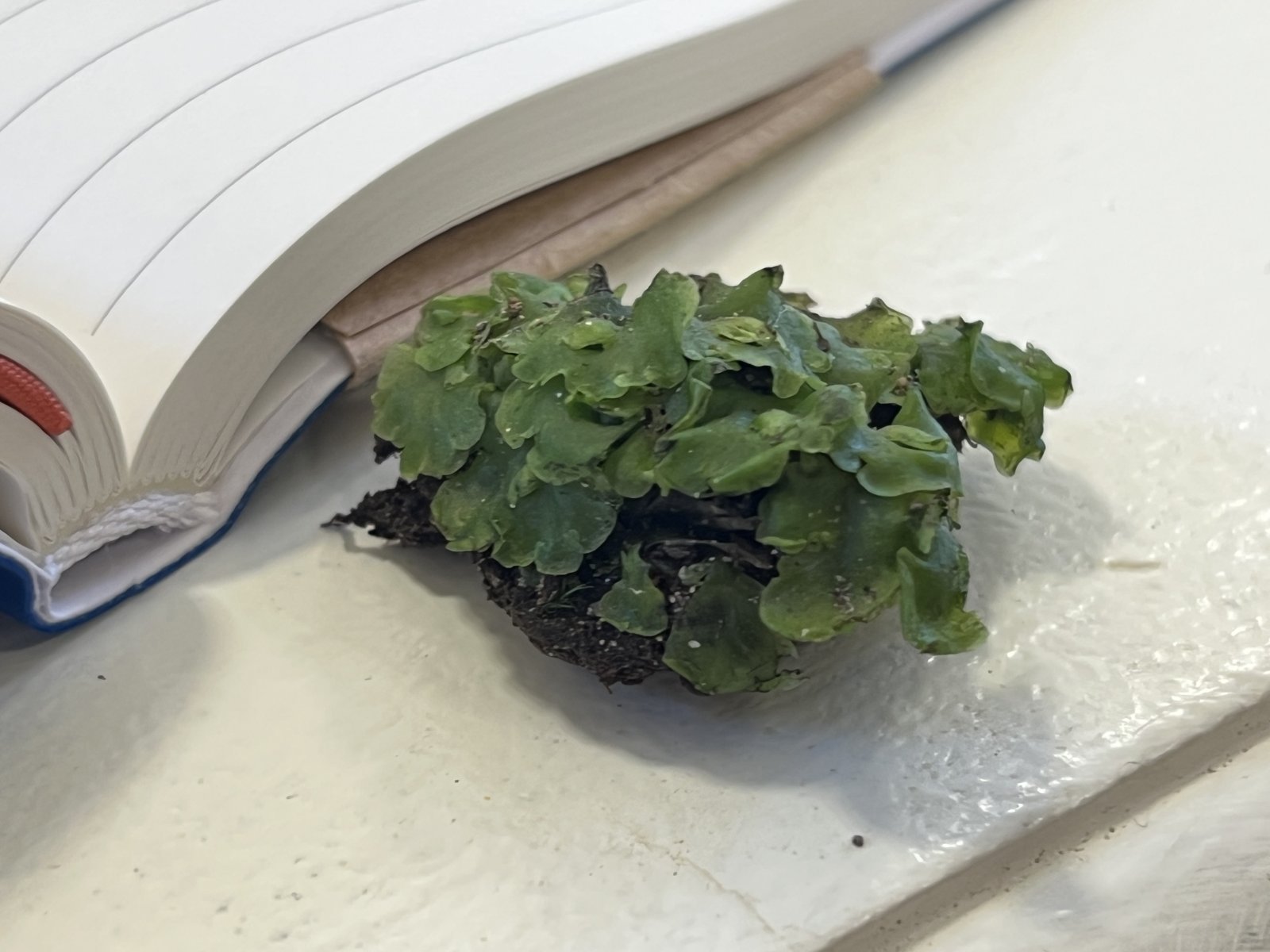
A thallose liverwort, probably a Pellia, beside my notebook.
The leafy ones were white earwort (Diplophyllum albicans), whose leaves are folded into two unequal lobes with a pale stripe down the middle, and creeping fingerwort (Lepidozia reptans), a delicate little thing with leaves split into finger-like lobes. Some of the leaves were almost see-through under the lens. Once you knew what to look for, the leaf shapes and the way they branched made them identifiable surprisingly quickly.
Joanne also had a couple of microscopes set up, and seeing the structure up close was fascinating.
One thing I hadn't really thought about: bryophytes don't have true roots. They have rhizoids, which anchor them, and they take in water and nutrients across their whole surface. That makes them very sensitive to their surroundings, so they're used as indicators of things like air quality. Certain species only turn up where the air is poor, and Joanne mentioned one you'd really only see after a site has been burned.
On the book: it's been around a long time, and an updated edition is planned for 2026 or 2027. Even though some of the people behind the original were Irish, Ireland has always played second fiddle in it, and the new edition is meant to give Ireland its proper place.
Then the mosses
Back in the presentation room, we moved on to mosses, starting with Sphagnum. These are the bog mosses, and most of the peat in our bogs was originally Sphagnum. Joanne explained that the different Sphagnum species can tell you what kind of bog you're looking at and whether it's in good health, because some only grow when certain conditions are met.
Then the two main groups: acrocarpous and pleurocarpous mosses. My primitive definition goes like this. Acrocarps are the bulbous, round, cushiony ones that grow upright. Pleurocarps are more branched and tree-like, spread out like a carpet and often have floppier foliage.
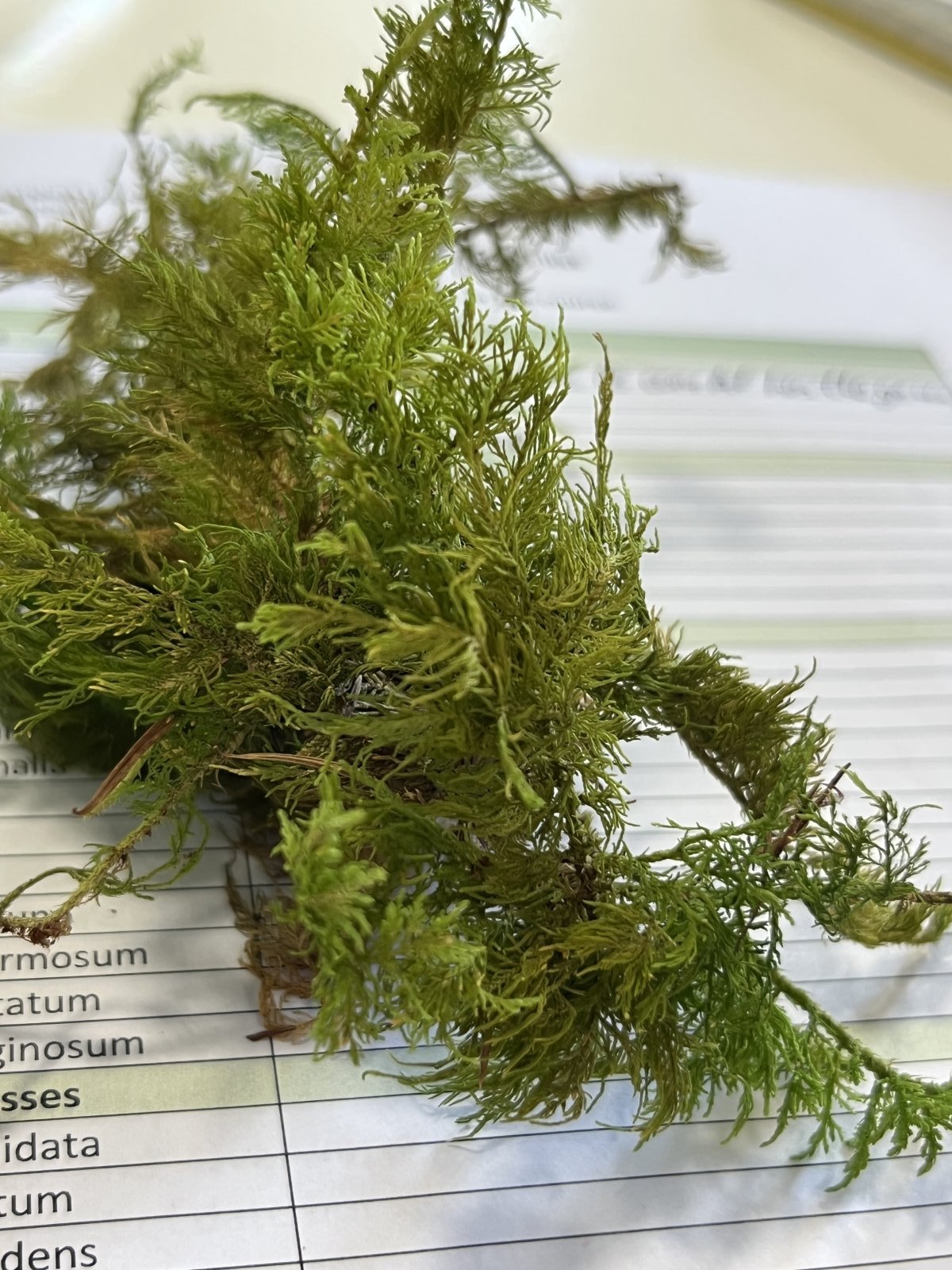
The fern-like shoots of a pleurocarp, probably common tamarisk-moss.
The pleurocarps on the table included common tamarisk-moss (Thuidium tamariscinum), with its finely divided, almost fern-like fronds, and little shaggy-moss (Rhytidiadelphus loreus), which is common on woodland floors. For the acrocarps there was silky forklet-moss (Dicranella heteromalla), which forms low, silky tufts with the leaves all bending the same way. There was also fox-tail feather-moss (Thamnobryum alopecurum), which grows like a miniature tree, the two shaggy-mosses Rhytidiadelphus triquetrus and R. squarrosus, and Hypnum jutlandicum. Most of the specimens had been collected in Cruagh Woods, where we were headed that afternoon.
We passed the specimens around the groups, asked plenty of questions and had another go on the microscopes. To be fair, the mosses were a lot easier, at least for telling that something was a moss and not a liverwort. Once you've got a few of the common ones in your head, the others start to stand out.
Joanne gave us notes on the basic differences and leaf structures, and she introduced the idea of a key. We didn't use one on the day, but from what I can gather it works a bit like a recipe: if the specimen has this feature, it's likely this; if it has that one, it's more likely that, and so on until you've narrowed it down. That's next on my list to learn.
Lunch
There's a café at Glencree, the Armoury Café, but I'd brought a packed lunch, as the email before the course suggested. I'd also bought a waterproof notebook for the day, which I'd never had before. The paper is coated, so you can write in the wet without the pages sticking together. For a group of plants that loves damp places, it makes a lot of sense.
Into Cruagh Woods
After lunch we met in the car park and headed for Cruagh Woods. My GPS signal wasn't great, so I went by the map. Out the Glencree gate, go left, up around the hairpin bends, right, then the next right onto the Old Military Road. Follow that around and down a bit, and Cruagh Woods is on your right.
It's a lovely setting, even though it's a plantation, mainly Sitka spruce, larch and Douglas fir. There was still a good amount of moss and other ground cover, ferns included. After a quick chat in the car park about the plan, we headed in, but rather than sticking to the trail we stepped off onto the forest floor and went looking for the things we'd seen that morning.
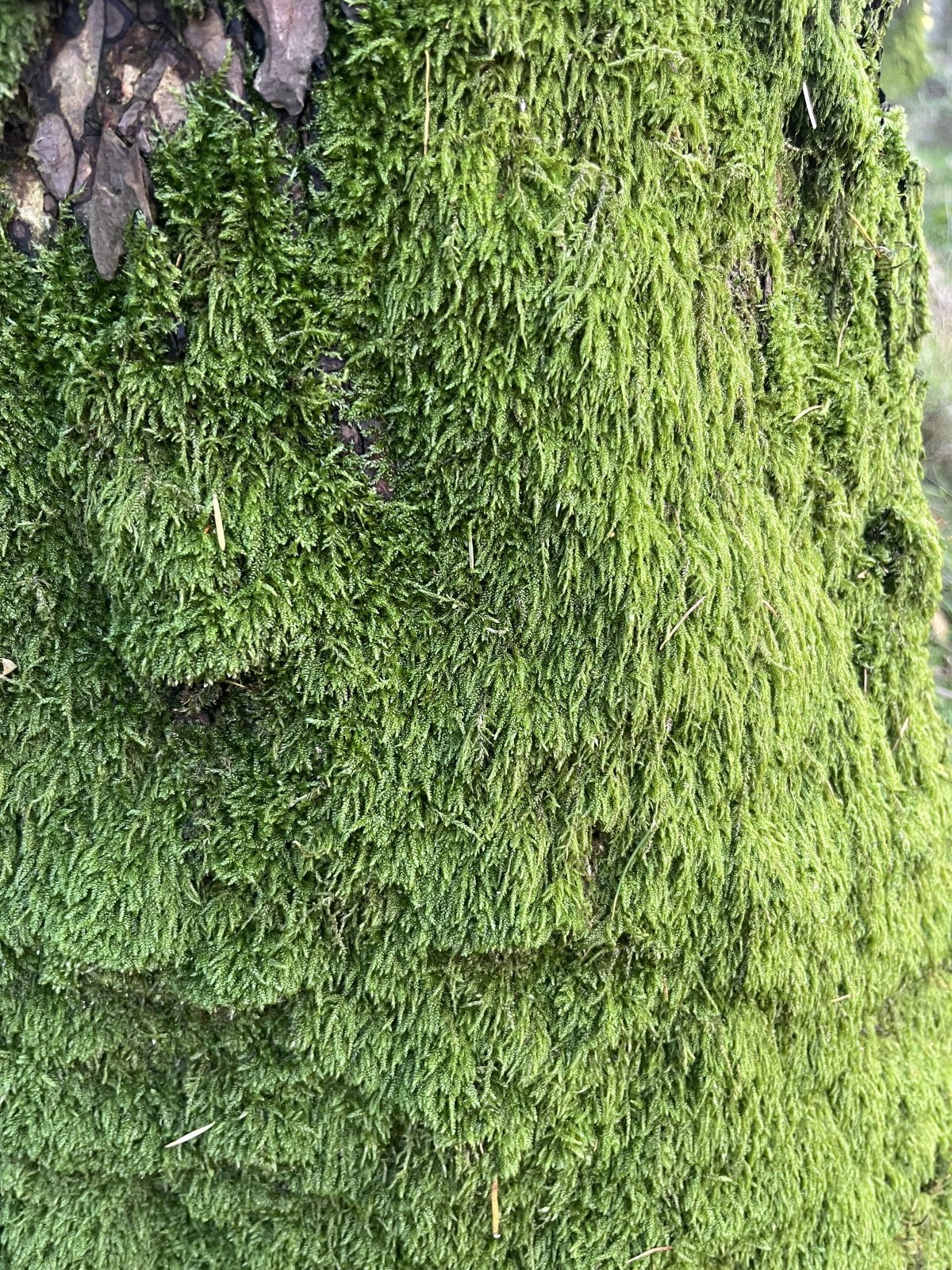
Moss carpeting a trunk in Cruagh Woods, probably mouse-tail moss.
We found plenty of what we'd seen indoors, plus several species we hadn't. One was a Polytrichum, a haircap moss. It looks like a little bottle brush, and it was the second bottle-brush type moss we'd seen that day. This one wasn't as translucent as the first: it was much darker green and almost waxy looking. That makes sense, as Polytrichum has thick leaves with rows of tiny ridges on top. There was a lot of it in there.
There was also a very spongy moss, which I'll have to get the name of, and a lot of the trees were covered in another moss hanging straight down like long hair, probably mouse-tail moss (Isothecium myosuroides), though I need to confirm that one.
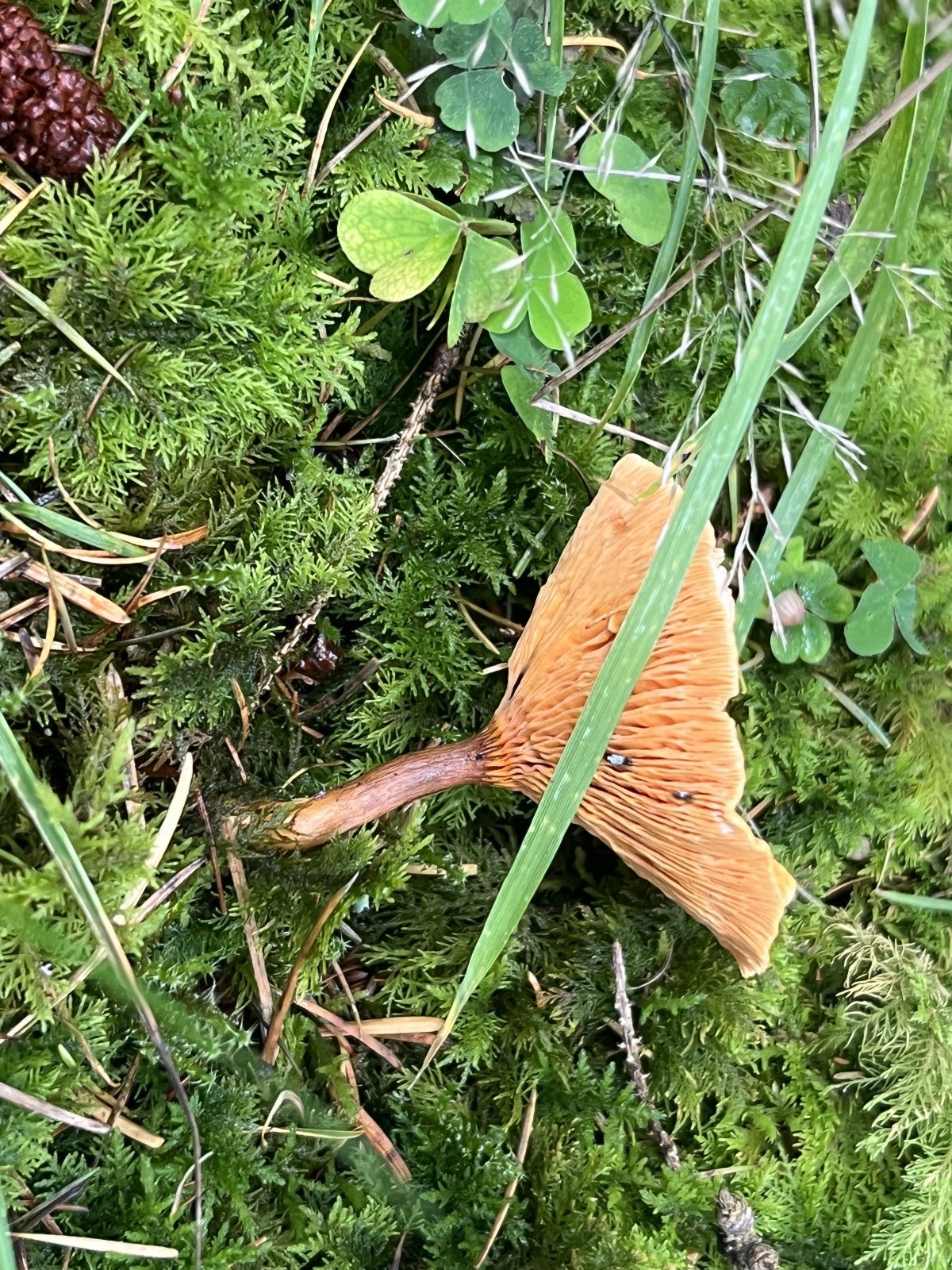
False chanterelle, with its forked orange gills, among tamarisk-moss.
There were fungi everywhere too, including false chanterelle (Hygrophoropsis aurantiaca), which is common in conifer woods, and we stopped to have a look at a few. Lots of saplings were coming up through the woodland as well. We did find a few small patches of liverwort, but the mosses were still much easier for me to pick out.
We kept working our way uphill, stopping to look and talk, until I had to leave just after 3pm to head back to Carlow and collect an Acer palmatum 'Beni Chidori' that was waiting for me.
Would I recommend it?
Yes, to anyone with an interest. The other people on the course were lovely, and Joanne was great. She answered everyone's questions and clearly knows her field, and ecology in general, inside out. I came away with pages of notes and a whole new group of plants to get to know.
The next day I was back out in the woods, this time at Altamont in Carlow, but that's one for another article.